
ESPRESSO VS COFFEE
Espresso vs coffee caffeine: which has more per shot, ounce and cup?
Espresso tastes stronger, but a full cup of brewed coffee can contain more caffeine. Compare concentration, serving size, shots, Americanos, lattes and filter coffee without mixing up the units.
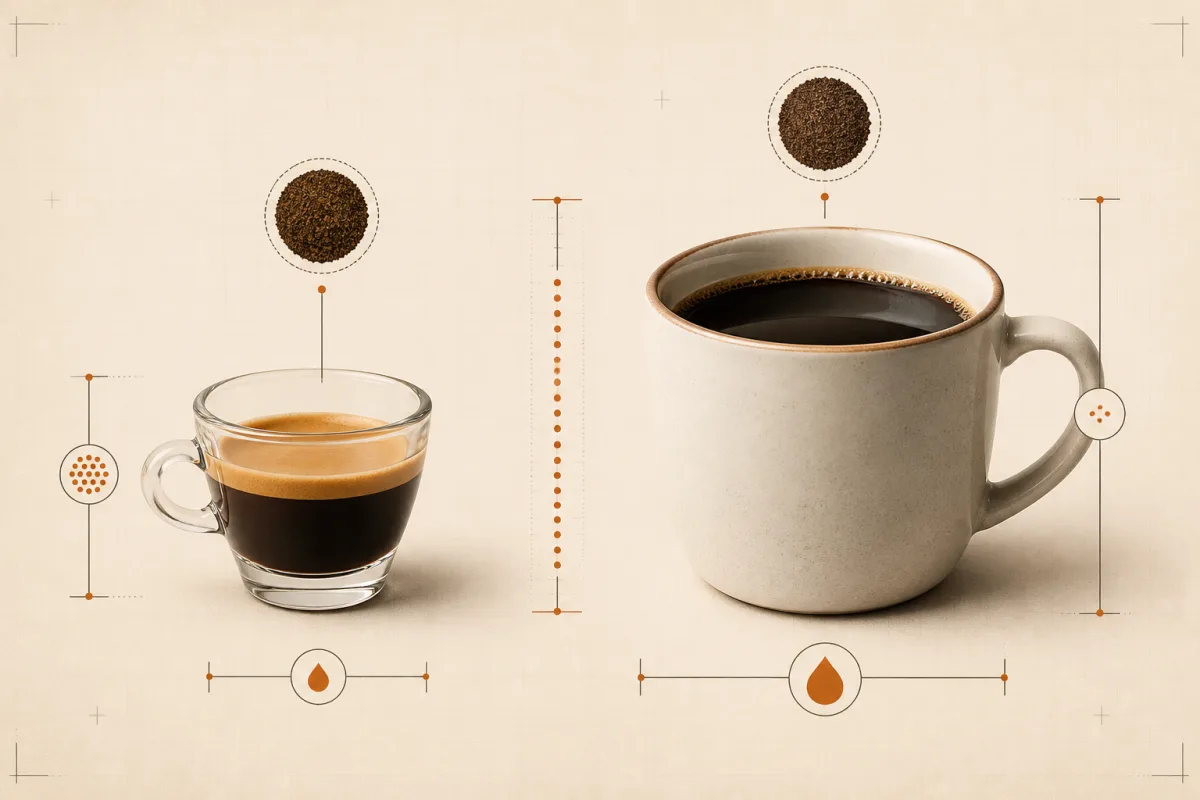
1. The answer depends on concentration or total serving
Espresso usually has far more caffeine per millilitre, but its serving is small. Brewed coffee is less concentrated and usually served in a much larger cup. A useful comparison must therefore specify per millilitre, per fluid ounce or per finished serving.
EFSA's practical reference values are about 80 mg for 60 ml of espresso and 90 mg for 200 ml of filter coffee. These are guidelines, not universal recipes: espresso wins on concentration while the total per serving is similar.
2. How much caffeine is in a shot of espresso?
A ‘shot’ is not globally standardized. A café may serve roughly 25–30 ml as a single, while 60 ml may represent a double; coffee dose and beverage yield also vary.
Treat EFSA's 60 ml and 80 mg as a useful double-size reference, not proof that every single shot contains 80 mg. For chain drinks, official size and shot data should take priority.
3. Why a cup of brewed coffee can contain more
Drip, pour-over and batch brewing use longer contact and are consumed in larger volumes. Even at a lower concentration, a 240–355 ml cup can accumulate more caffeine than a small espresso.
The FDA gives 113–247 mg as a typical range for 12 fl oz of regular brewed non-specialty coffee in the US. The wide range shows why size, beans and recipe matter more than the word ‘coffee’ alone.
Common comparisons (approximate)
| Espresso | 60 ml | about 80 mg | High concentration, small serving |
| Filter coffee | 200 ml | about 90 mg | Lower concentration, similar total |
| Regular brewed coffee | 355 ml | about 113–247 mg | Large cups may total more |
| Americano / latte | Recipe varies | Add the shots | Water or milk does not remove caffeine |
4. How to count Americanos, lattes and iced coffee
An Americano's caffeine mainly follows the number of espresso shots. Adding water lowers concentration but does not remove caffeine. A latte made with the same number of shots will usually start with a similar caffeine total.
Milk, syrup and ice do not erase caffeine either. Cold brew cannot be predicted from its name: concentrate ratio, dilution and serving size all matter.
5. Why beans, dose and extraction change the result
Robusta generally contains more caffeine than Arabica. Blend, coffee dose, grind, time, temperature and beverage yield also affect extraction. Roast level alone cannot reliably predict milligrams in the cup.
Bitterness and perceived strength are poor caffeine meters. A mild-tasting large or multi-shot drink may still deliver a high total dose.
6. The most accurate way to compare and track
Use official brand data first, then confirm size and shot count. If no value exists, use a category range and label it clearly as an estimate; do not copy one café's number to another.
Track drink name, volume, shots, milligrams and time. The FDA cites 400 mg per day as an amount not generally associated with negative effects for most healthy adults, while sensitivity and individual circumstances vary.
TAKEAWAY
Espresso is more concentrated—not automatically higher per cup
Compare concentration, serving volume and shot count together. For actual intake, total milligrams in the finished drink matter more than how strong it tastes.
References
- EFSA — Caffeine: amounts in common foods and drinks
- U.S. FDA — Spilling the Beans: How Much Caffeine Is Too Much?
- USDA FoodData Central — Food nutrient database
General education only. Values are approximate; use official product data when available. This is not medical advice.