
CAFFEINE & BLOOD PRESSURE
Does caffeine raise blood pressure? Short-term effects, long-term risk and how to measure
Caffeine can temporarily raise blood pressure, but a change after one cup is not the same as chronic hypertension. Separate the acute response from long-term habits and individual sensitivity.
1. The short answer: a temporary rise is possible
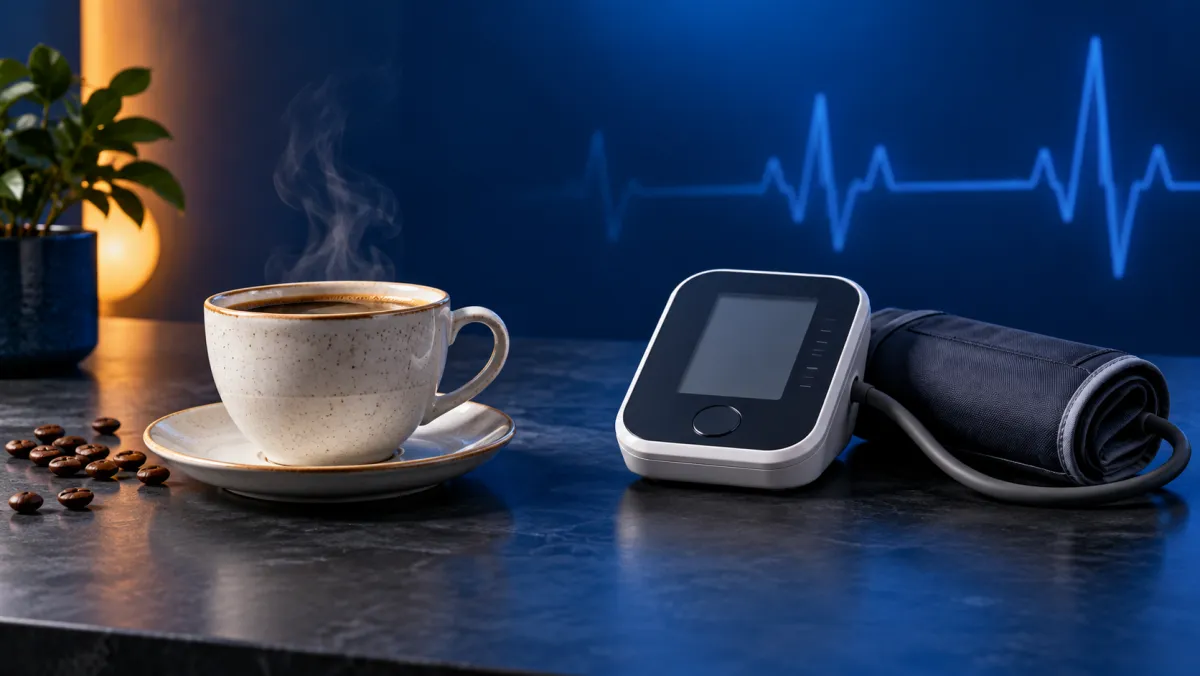
Caffeine can briefly raise systolic and diastolic pressure in some people, particularly after a larger dose or in people who rarely consume it. An acute response is not the same as persistent hypertension.
Pure caffeine and coffee should also be separated. Coffee contains other bioactive compounds, while studies differ in dose, brew, timing and participants' usual habits.
2. Why caffeine affects blood pressure
Caffeine blocks adenosine receptors and may temporarily increase sympathetic activity, changing vascular tone and cardiovascular responses.
Regular users may develop some tolerance, but it varies. Poor sleep, anxiety, exercise, nicotine and medicines can also affect the reading.
3. How large is the short-term change?
A 2023 dose-response meta-analysis of randomized trials reported average increases of about 1.94 mmHg systolic and 1.66 mmHg diastolic with caffeine supplementation.
Those pooled averages do not predict one person's response. Dose, timing and habitual use matter, and a high-dose energy product is not equivalent to ordinary coffee.
4. Does habitual coffee raise hypertension risk?
Long-term evidence is less direct. Several cohort analyses have not found higher hypertension risk with habitual coffee, and some report an inverse association, but observational findings do not prove protection.
The practical conclusion is that caffeine can change blood pressure acutely, while long-term risk depends on many factors. Your repeated measurements matter more than a population average.
5. How to check your own response
Compare two similar days using the same validated upper-arm monitor: one without caffeine and one with your usual fixed serving. Rest first, measure a baseline, then repeat about 30–120 minutes later under the same conditions.
Do not diagnose yourself from one result. If a repeatable rise or symptoms occur, bring the drink, milligrams, timing and readings to a clinician.
6. Should you avoid coffee before measuring blood pressure?
For a comparable resting reading, the American Heart Association advises avoiding caffeine, smoking and exercise for 30 minutes, emptying the bladder, resting quietly for five minutes and positioning the arm correctly.
If testing a caffeine response, establish a standardized baseline first. Inconsistent technique can create more noise than the small change you are trying to detect.
7. A safer approach if you have hypertension
A hypertension diagnosis does not automatically require eliminating all coffee, but high-dose caffeine, energy drinks and supplements deserve extra caution. Choose known amounts, start smaller and avoid stacking sources.
If pressure is uncontrolled, medicines are being adjusted or you react strongly, ask your care team about an appropriate personal limit. Do not change treatment based on a general article.
8. When to seek medical care
If a reading is 180/120 mmHg or higher, repeat it after at least one minute and contact a health professional immediately if it remains that high. With chest pain, shortness of breath, weakness, vision change or difficulty speaking, seek emergency care.
Repeated high readings, palpitations, headache or dizziness also warrant assessment. Caffeine may be one clue, not the only possible cause.
TAKEAWAY
Standardize the measurement before blaming the coffee
Log the drink, caffeine milligrams, time and properly measured pressure. A repeated personal pattern is more useful than a single reading.
References
- Systematic review and dose-response meta-analysis of randomized trials (2023)
- American Heart Association — Home Blood Pressure Monitoring
- Systematic review and meta-analysis of coffee and hypertension risk
- U.S. FDA — Spilling the Beans: How Much Caffeine Is Too Much?
General health education only; not a diagnosis, emergency service or individualized medical advice.